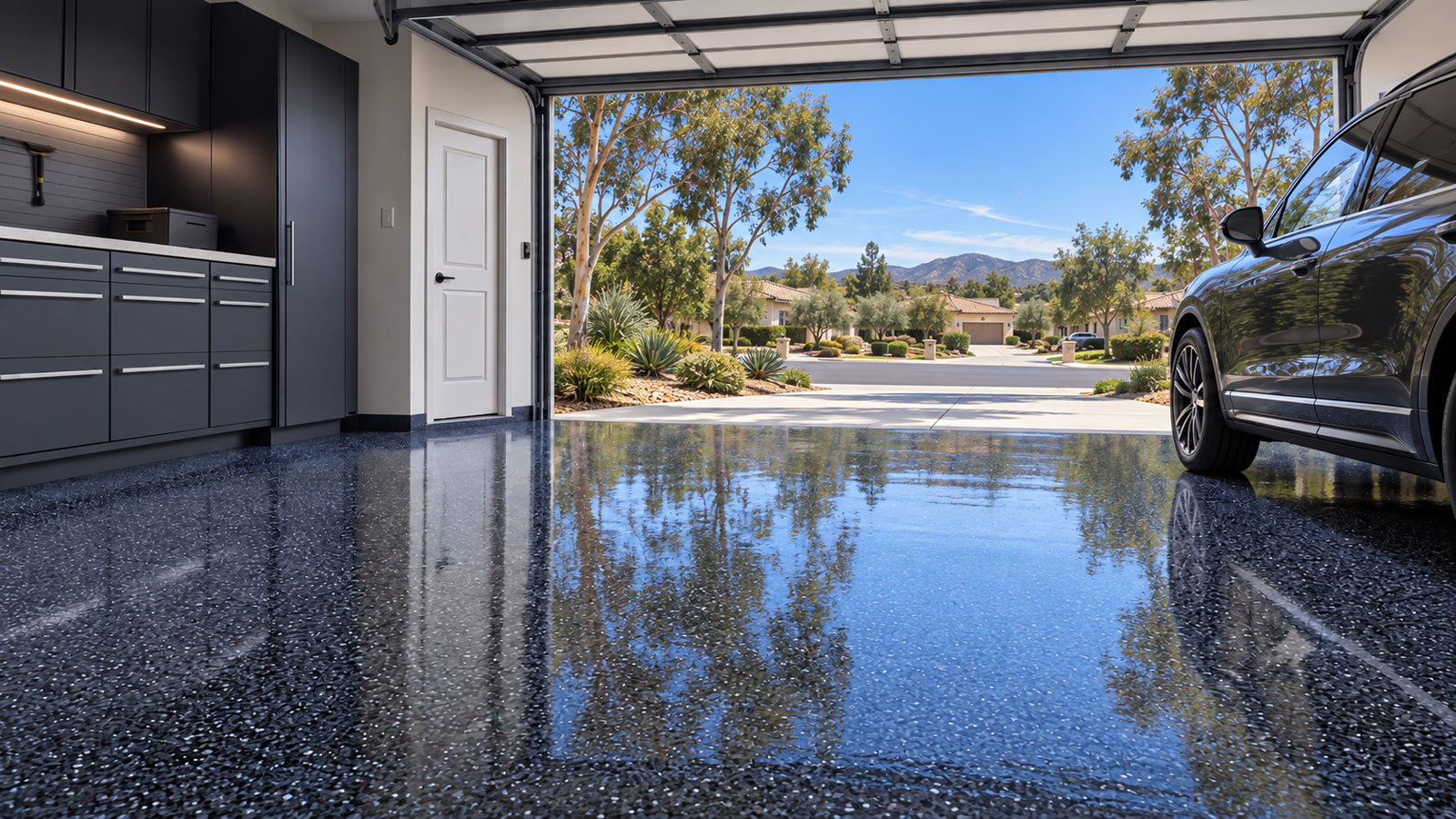
Garage Floor Coating in Corona, CA
Floor Coating Services in Corona, CA
Corona sits where plains, canyons, and foothills meet. The city is framed by the Santa Ana Mountains, Chino Hills, and Gavilan Hills, while I-15 runs south through Temescal Canyon. That means one Corona garage can have a broad, flat suburban approach while another sits behind a sloped driveway near the foothills.
The housing stock is concentrated in the late twentieth century. More than half of Corona homes were built during the 1980s and 1990s, with another substantial share added in the 2000s. Many garage slabs are therefore mature enough to have previous paint, repairs, sealers, cabinets, or DIY coatings without being especially old by Southern California standards.
For a Corona project, the two most useful questions are what has happened to the concrete since it was poured and how the property meets the surrounding terrain. Surface history determines grinding and repair. Driveway grade, drainage, and sun exposure determine what deserves attention at the garage opening.
Local Market Insight
Corona's housing boom produced many 1980s and 1990s garages, while the city's foothills and canyon edges create real differences in driveway grade and water movement. Slab history and site geometry should be checked separately.
What Affects the Cost of Garage Floor Coating in Corona?
Garage floor coating in Corona typically runs $6–$12 per square foot, with a typical two-car garage around $3,000–$5,500. Final price depends on preparation, repairs, old coating removal, garage size, edge details, and the finish system chosen for the actual use of the space.
Previous coatings and surface treatments
A 1980s or 1990s garage may have been painted, sealed, patched, or coated more than once. Weak or unknown layers usually need to be removed before a new system is installed.
Cracks and repair history
Mature slabs often contain shrinkage cracks, patched areas, anchor holes, or repairs from earlier improvements. Stable concrete can be coated, but damaged areas should be addressed first.
Foothill driveway grade
South and east Corona properties can sit closer to hills and canyons. A steeper driveway changes how the garage threshold should be inspected for runoff, debris, and edge transitions.
Temescal-area drainage and water paths
Corona is crossed by creeks, washes, and drainage channels. That does not mean every garage has a drainage issue, but homeowners should know whether rain or irrigation reaches the garage opening before the floor is coated.
Strong sun at open garage doors
Direct Inland Empire sun can reach the first several feet of a garage floor. A sun-resistant topcoat is most useful where the exposure is real rather than as an automatic add-on everywhere.
Garage size, storage, and transitions
Multi-bay garages, steps, stem walls, cabinets, utility zones, and storage areas add labor beyond simple floor square footage and should be measured as part of the project.
Call for a clear, project-specific estimate — or request one online.
Local Garage-Floor Conditions in Corona
A large share of Corona housing dates to the 1980s and 1990s. Those floors may still be structurally sound while carrying several generations of paint, sealers, patches, or storage-related wear that must be removed or repaired before coating.
Foothill and canyon-edge properties introduce a different question: how does the driveway meet the garage? A sloped approach can concentrate runoff and debris at the threshold even when the interior slab is in excellent condition.
The practical approach is to inspect both the floor and the property. Preparation should follow the actual concrete, while drainage and sun exposure should be handled as site conditions rather than assumed from the city name.
Corona's 1980s and 1990s Housing Boom Still Shows Up in the Garage
More than half of Corona's housing was built in the 1980s and 1990s. That creates a large pool of garages old enough to have accumulated repairs and surface treatments but young enough that many slabs remain fundamentally sound.
The common preparation question is not whether the concrete is old. It is whether the slab has paint, sealer, a failed DIY coating, patch material, oil contamination, or repairs that must be addressed before the new system bonds to the floor.
A clean-looking garage can still need aggressive preparation if an invisible sealer or weak coating remains on the surface.
Mountains, Canyons, and Plains Change the Threshold More Than the Coating
Corona is surrounded by the Santa Ana Mountains, Chino Hills, and Gavilan Hills, and the southern part of the city reaches into Temescal Canyon. That landscape creates a wider range of driveway grades than a uniformly flat suburb.
At a hillier property, the installer should look at the apron, door line, and runoff path before the garage is emptied. A coating can protect the slab, but it does not redirect stormwater or correct a poorly drained threshold.
Once those site conditions are understood, the floor system can be chosen around the concrete condition, desired appearance, traction, and return-to-service needs.
Questions to Answer Before Coating a Corona Garage
- Was the floor ever painted, sealed, patched, or previously coated?
- Are visible cracks and repairs stable?
- Does the driveway pitch toward or away from the garage?
- Is there evidence that rain or irrigation reaches the threshold?
- How far does direct sun reach into the garage?
- How many bays, steps, cabinets, and wall transitions are included in the work?
Corona Garage Floor Coating FAQs
Are Corona garages mostly newer concrete?
Many homes were built in the 1980s and 1990s, but that still gives garage floors decades of use. Previous coatings, repairs, oil staining, and sealers can matter even when the slab itself is sound.
Do south Corona garages need special treatment because of the hills?
Not necessarily a different coating system. The important differences are often driveway slope, drainage at the door, debris, and sun exposure, which should be checked at the individual property.
Should old epoxy or floor paint stay under the new coating?
Only if it is proven sound and compatible. Weak, peeling, or unknown material is commonly removed so the new system bonds to properly prepared concrete.
Can a coating stop runoff from entering a sloped garage?
No. The coating can protect the concrete surface, but active water-entry or drainage problems need to be addressed separately.
Corona Neighborhoods & Local Context
Phone Quote Line
Speak with a floor coating specialist about your project and get a realistic estimate range.
(951) 400-4033Typical Project Cost
$3,000–$5,500
Typical range for a two-car garage. Final pricing depends on floor size, concrete condition, prep work, coating type, and finish options.
Helpful Guides